



CFA® Chief Investment Officer
We connected to the nascent internet via telephone dial-up using a modem that made the most ridiculous sounds as it established a connection. In those days, I learned to research corporate value based on the foundational principles of finance. Metrics like return on equity, expected growth rates, asset turnover, and operating leverage helped us formulate expected values.
Back then, valuation metrics tended to stay within certain well-defined bounds. Growth rates had natural limits. There were only so many resources any one company (or industry) could consume, which naturally constrained how fast it could grow. When the telecom and technology boom hit later that decade, we marveled at how fast things were changing, but we still believed in those inherent boundaries. We used to joke that if the tech companies continued to grow at such elevated levels for as long as projected, they would eventually become the entire economy.
Here we sit some 30 years later, and the technology industry represents approximately half the value of the stock market—over half if you factor in the expected values of massive companies that aren’t even publicly traded yet, but soon will join the indexes like SpaceX (which went public a couple of weeks ago, but not yet in the indexes), Anthropic, and OpenAI. One of the most dangerous phrases in investing is “It’s different this time.” There is some truth that the current economic environment we’re in has its own distinct flavor. However, the reality is that core financial truths endure.


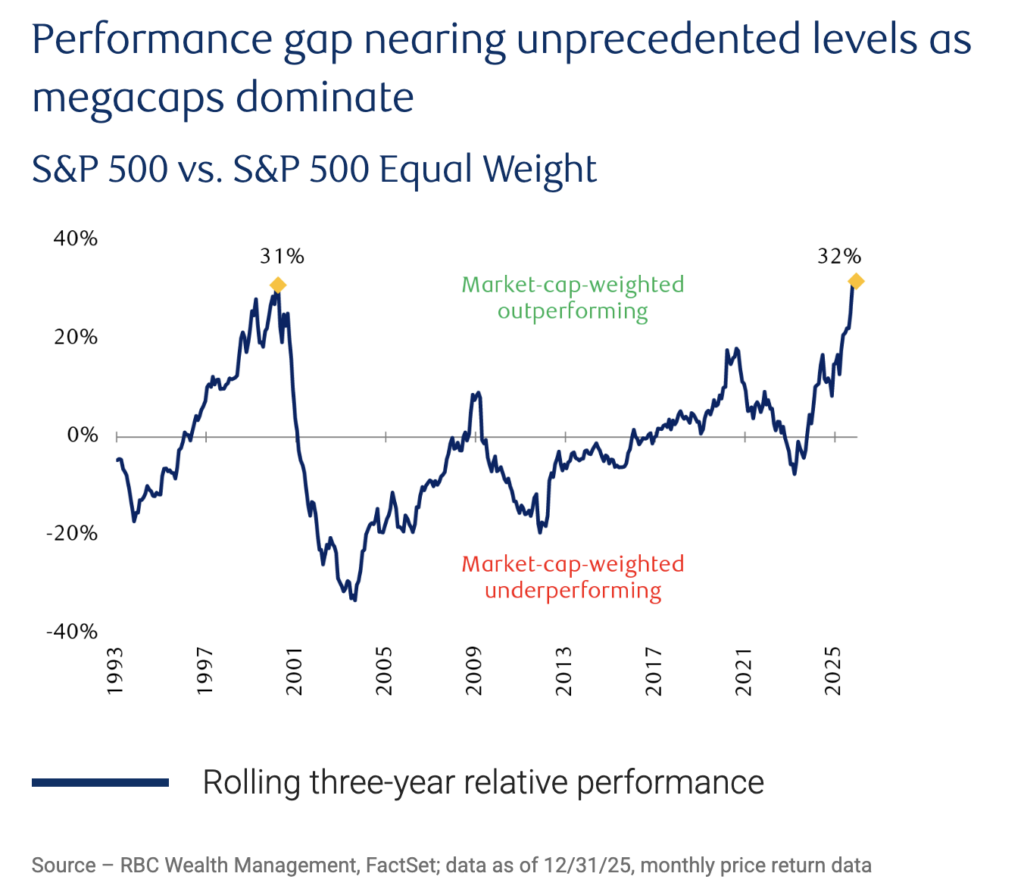
The stock market at its peak in early 2000 had a high concentration of value in its top ten companies, much like today’s market. Back then, the top ten accounted for roughly 27% of the index, but the industry makeup was diversified with giants like Merck, Walmart, GE, and ExxonMobil making the list.1 Today, the top ten companies command around 40% of the market’s value, and all ten reside in technology or communications (if you consider Amazon a tech giant instead of an online bookstore). If valuations hold by the time SpaceX, OpenAI, and Anthropic join the index, that concentration could cross 50%.
There is another massive structural difference. In the late 1990s, the top 100 was littered with tech companies that didn’t make a dime. Today, while a few names trade at eye-popping valuations without earnings, the big tech giants driving the market are obscenely profitable. They are breaking through many of the historical upper limits of traditional financial metrics. For example, their net profit margins are nearly twice those of US Steel back when it controlled 65% of the steel industry.2
The Gilded Age (1870–1900) also had record profitability due to tremendous economic growth driven by a technological revolution. Railroads were the 19th-century version of the internet, bringing people and commerce closer together. It was also an era characterized by unchecked monopolies. While these “titans of industry” undeniably built a more efficient economy, there were ugly downsides: pollution, political corruption, poor labor practices, and extreme wealth inequality.


Yet, even at the peak of these historic monopolies—Rockefeller’s Standard Oil, Carnegie’s US Steel, Vanderbilt’s New York Central Railroad, and the consolidations financed by JP Morgan—net profit margins were significantly lower than those of today’s tech giants. Standard Oil controlled around 90% of the oil industry3 , but it required an immense amount of physical capital and human labor to earn those returns. Today’s tech giants don’t need nearly as many people, and the capital-intensive portions of their hardware businesses have largely been outsourced overseas.
A major distinction between modern tech “monopolies” and those of yesteryear is how they achieved dominance. Past monopolies relied heavily on aggressive physical consolidation. Today, tech giants dominate their respective niches through network effects—a phenomenon in which a product or service becomes more valuable to its users the more people use it. Consider the Apple ecosystem. My own family can’t stand that I have an Android because it doesn’t sync seamlessly with their Apple features. Because so many people use Apple products, joining that ecosystem becomes highly valuable to new users. (Still, I refuse; I happily frolic in the Google ecosystem).
While there are occasional consolidation plays—Meta purchasing Instagram to cement its dominance in social media advertising is a prime example—most tech giants maintain distinct “mini-monopolies” in their core spaces, such as Google maintaining an approximate 90% share of global search.4 Instead of traditional mergers, the more worrisome trend today is the exploding volume of cross-investments. If Apple invests $100 billion in Google, which invests $100 billion in Amazon which invests $100 billion back in Apple is the underlying economy actually better off? It starts to feel like that classic Three Stooges bit explaining the illusion of money. Click on the short video below.
In that respect, our current environment also resembles the Keiretsu system formed by Japanese conglomerates in the late 1980s. In a traditional Keiretsu, a central banking entity coordinated a collective alliance of manufacturers, supply chain partners, distributors, and financiers. Through extensive cross-ownership, these individual companies acted in unison as a singular giant monopoly.
Fueled by this structure, the Nikkei 225 skyrocketed from around 8,000 points in 1982 to an astronomical peak of 38,915 just seven years later. Flush with cash, the billionaires of that era began buying up trophy assets in the United States—most famously marked by tycoon Minoru Isutani buying the Pebble Beach golf resort for a staggering $841 million.5

Ultimately, none of these preceding eras truly capture what we are witnessing today. Today’s technology companies are arguably more powerful than any monopoly in industrial history. Furthermore, one could argue that the future of the AI era is more dangerous and uncertain than the advances of the past.
Whereas the dot-com boom brought transparent information and widespread efficiency to everyday businesses, the AI era frequently obscures information. Facts are becoming harder to discern from AI-generated “hallucinations” or illusions. Whereas the Gilded Age delivered manufacturing power and competitive advantages to the US economy, the AI era threatens the very existence of certain knowledge-based industries—while carrying all the same historic downsides of pollution, political corruption, poor labor practices, and extreme wealth inequality. At the same time, massive cross-investments obscure the true worth of these tech companies to society, making their ultimate return on investment highly questionable.
Historically, the stock prices of dominant monopolies struggled after their peaks. I hesitate to guarantee this outcome for today’s behemoths. The outcome depended on external factors.
As the froth of those big names dissolved in the early 2000s, there were still plenty of excellent opportunities in the broader market beneath the surface (as I wrote about in The Taoist Farmer).

It is difficult to predict exactly how or when this market pendulum will swing back. The Gilded Age gives me some hope. People eventually grew tired of the societal downsides of massive conglomerates, and they elected representatives who passed common-sense laws to break up the giants and regulate unsafe labor. The worry today, of course, is that technology changes exponentially faster than the makeup of Congress. Given the current low approval ratings of Capitol Hill, it would be surprising to see meaningful, timely legislation capable of tempering the negative effects of Big Tech. Furthermore, the sheer volume of cash these companies wield for lobbying is staggering — frequently blurring the lines as representatives can and do pass legislation written by lobbyists.
To put their size into perspective, the amount of money Big Tech will spend just this year on data centers and infrastructure is large enough to buy out massive, standalone corporations like McDonald’s, PepsiCo, Amgen, or Verizon. In essence, these tech giants believe that these $190 billion investments will yield a higher return than owning all of Pepsi. As the Taoist Farmer would say: maybe.
Investing successfully today comes down to how you expect this capital cycle to play out. Our investment belief is that while these large technology companies will continue to perform well operationally, they will likely experience a growth slowdown over the coming years as this unprecedented capital expenditure cycle peaks. For them to maintain their current growth rates, their capital expenditures cannot just stay at their already sky-high levels—they have to keep increasing them. In the long run, that simply isn’t mathematically feasible. Furthermore, building out thousands of data centers that consume immense amounts of electricity will significantly increase the capital intensity of the tech sector, which should ultimately compress their historic profit margins – to say nothing of the environmental impact.
On the positive side, the efficiencies gained from these new AI technologies will inevitably benefit companies in non-tech industries. Because of this dual reality, we continue to maintain a highly balanced portfolio. We pair exposure to these tech giants with traditional, high-quality value holdings. We also see strong fundamental value in international markets, emerging markets, small-caps, mid-caps, and commodities.
As history repeats itself, and change is inevitable, it is likely the tech companies will, at some point, face a wall of resistance whether it be from Congress, citizens fed up with an ever-widening wealth gap, or simply the gravity of a slowing growth trajectory. It is also possible that the current AI narrative will fail to fully materialize. What if the extent of its capability peaks at writing low-level code, generating images and videos, and streamlining internet searches? It will be interesting to see how this era echoes into the future.